PENERAPAN NILAI-NILAI HUMANISTIK PADA PEMBELAJARAN PENDIDIKAN AGAMA ISLAM DI SEKOLAH DASAR NEGERI NAGASARI III KARAWANG BARAT
DOI:
https://doi.org/10.33511/qiroah.v15n1.44-54Abstract
This research aims to understand the application of humanistic values and the supporting and inhibiting factors in the implementation of these values in Islamic education teaching at Nagasari III State Elementary School in Karawang Barat. The research method used is qualitative with a descriptive approach. Data were collected through observation, interviews, and documentation. The subjects of the research consisted of the school principal, Islamic education teachers, and two sixth-grade students, totaling four informants. The research findings indicate that the application of these values within the school culture, the strategies used by teachers to instill humanistic values, classroom interactions and dynamics, and student experiences all play a role. Support factors include the active role of the school principal and curriculum policies that provide flexibility for implementing humanistic values. However, there are also challenges, such as adaptation issues for both teachers and students, as well as challenges related to adapting to the independent curriculum from both the teacher and student perspectives.
References
Ali, Dukroini, Bayu Mujrimin, and Miza Opiyanti Sekolah Tinggi Agama Islam Ibnu Sina Batam. “Arah Baru Pengembangan Pendidikan Agama Islam Dalam Era Disrupsi.” Jurnal Arriyadhah XX, no. Ii (2023): 70–78. https://jurnalstaiibnusina.ac.id/index.php/ary.
Amin, Nur Fadilah, Sabaruddin Garancang, and Kamaluddin Abunawas. “KONSEP UMUM POPULASI DAN SAMPEL DALAM PENELITIAN.” Jurnal Pilar:Jurnal Kajian Islam Kontemporer 14, no. 1 (2023): 15–31. https://doi.org/10.21070/2017/978-979-3401-73-7.
Dinda, Taniya, Agnesya Hutasoit, Hieronymus Soerjatisnata, and Agus Triono. “Pemenuhan Hak Atas Pendidikan Bagi Masyarakat Sebagai Hak Asasi Manusia Pasca Putusan Mahkamah Konstitusi No . 3 / PUU-XXII / 2024,” 2025, 2119–26.
Khofifah, Nurul. “Metode Pengajaran Agama Islam Perspektif Zakiah Daradjat Dan Relevansi Terhadap Pendidikan Agama Islam.” UIN Fatmawati Sukarno Bengkulu, 2022.
Meyniar Albina, and Krisna Bayu Pratama. “Peran Tujuan Pembelajaran Dalam Perencanaan Pembelajaran : Dasar Untuk Pembelajaran Yang Efektif.” Harmoni Pendidikan : Jurnal Ilmu Pendidikan 2, no. 2 (2025): 55–61. https://doi.org/10.62383/hardik.v2i2.1233.
Munfaizah. “Melalui Strategi True or False Pada Siswa Kelas Vi.” Wulang: Jurnal Ilmiah Pendidikan Guru Madrasah Ibtidaiyah 03, no. 1 (2025): 49–68.
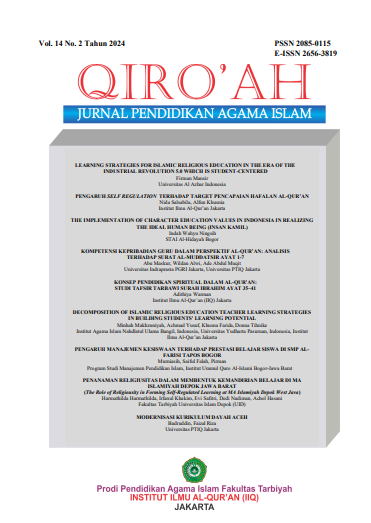
Murniasih, Saiful Falah, and Pirman. “Pengaruh Manajemen Kesiswaan Terhadap Prestasi Belajar Siswa Di Smp Al-Farisi Tapos Bogor.” Qiro’ah: Jurnal Pendidikan Agama Islam 14, no. 2 (2024): 215–28. https://ejurnal.iiq.ac.id/index.php/qiroah/article/view/2383.
Pristiwanti, Desi, Bai Badariah, Sholeh Hidayat, and Ratna Sari Dewi. “Pengertian Pendidikan.” Jurnal Pendidikan Dan Konseling 4, no. 2 (2022): 7911–15. https://doi.org/10.33387/bioedu.v6i2.7305.
Rahmatia, Sitti Ratna Dewi. “Konsep Pendidikan Humanisme Dalam Pengembangan Pendidikan Islam.” Jurnal Pendidikan Ar-Rashid 7, no. 1 (2022): 1–9.
Safrudin, Rizal, Zulfamanna, Martin Kustati, and Nana Sepriyanti. “Penelitian Kualitatif.” Journal Of Social Science Research 3, no. 2 (2023): 1–15.
Sholahudin, Tammam, Ibnu Abid, Mufid Ikhwanudin, Muhammad Naufal Arrizky, and Umar Muhtar Al-Ghozali. “Evaluasi Hasil Pembelajaran Pendidikan Agama Islam (PAI) Tinjauan Terhadap Ayat Al-Qur’an Dalam Aspek Kognitif, Afektif, Dan Psikomotorik.” Ainara Journal (Jurnal Penelitian Dan PKM Bidang Ilmu Pendidikan) 6, no. 1 (2025): 165–71. https://doi.org/10.54371/ainj.v6i1.808.
Subhaktiyasa, Putu Gede. “Pemahaman Komprehensif Perlaku Membolos Siswa.” Jurnal Ilmiah Profesi Pendidikan 9 (2024): 2721–31.
Sugiyono. Metode Penelitian Pendidikan (Pendekatan Kuantitatif, Kualitatif, Dan R&D). Alfabeta, 2015.
“Undang-Undang Republik Indonesia Nomor 20 Tahun 2003 Tentang Sistem Pendidikan Nasional, Pasal 1 Ayat (1).” Lembaran Negara Republik Indonesia Tahun 2003 Nomor 78, n.d. https://peraturan.bpk.go.id/Home/Details/43920/uu-no-20-tahun-2003.
Downloads
Published
Issue
Section
License
Copyright Notice
Authors who publish with Qiro'ah: Jurnal Pendidikan Agama Islam agree to the following terms:
-
Copyright Retention: Authors retain copyright and grant the journal right of first publication with the work simultaneously licensed under a Creative Commons Attribution License.
-
Licensing: The work is licensed under a Creative Commons Attribution 4.0 International License (CC BY 4.0), which permits others to share (copy and redistribute the material in any medium or format) and adapt (remix, transform, and build upon the material) for any purpose, even commercially, provided the original work is properly cited and initial publication in this journal is acknowledged.
-
Post-Publication Distribution: Authors are permitted and encouraged to post their work online (e.g., in institutional repositories or on their website) prior to and during the submission process, as it can lead to productive exchanges, as well as earlier and greater citation of published work.