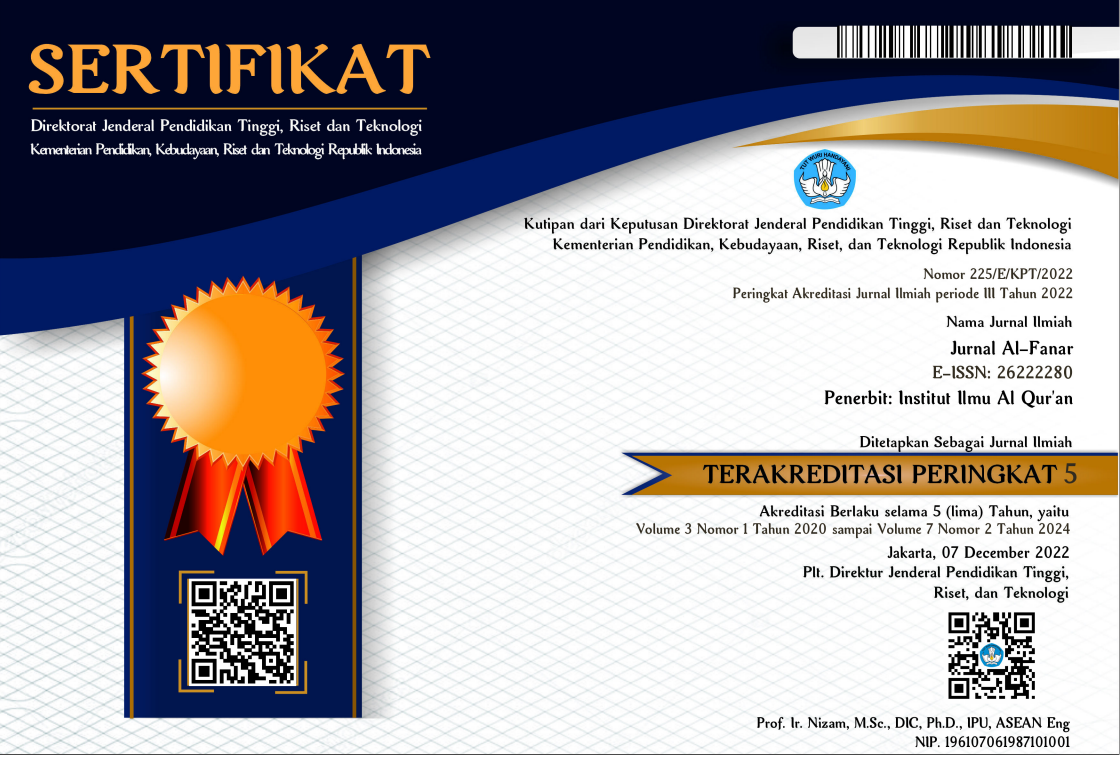
About the Journal
AL-FANAR: Jurnal Ilmu Al-Qur’an dan Tafsir is an international peer-reviewed journal dedicated to advancing scholarly research in Qur’anic studies and tafsir through rigorous, innovative, and interdisciplinary approaches. The journal provides an academic forum for researchers, lecturers, students, and practitioners to engage in critical discussions on the Qur’an, its interpretation, and its relevance to contemporary intellectual, social, cultural, and global challenges. By fostering dialogue across diverse scholarly traditions and geographical contexts, AL-FANAR contributes to the development of Qur’anic scholarship as a dynamic field of inquiry that bridges classical Islamic heritage with contemporary academic perspectives.
The journal welcomes original research articles that offer theoretical, methodological, textual, historical, or empirical contributions to the study of the Qur’an and its interpretation. Areas of interest include, but are not limited to, Qur’anic studies; ‘Ulum al-Qur’an; classical and contemporary tafsir; Qur’anic hermeneutics; living Qur’an studies; regional and comparative Qur’anic studies; methodologies of Qur’anic interpretation; Qur’an and education; Qur’an and law; Qur’an and economics; as well as interdisciplinary engagements between the Qur’an and the social sciences, humanities, and contemporary global issues. All submissions undergo a rigorous double-blind peer-review process to ensure the highest standards of academic quality, originality, and scholarly integrity.